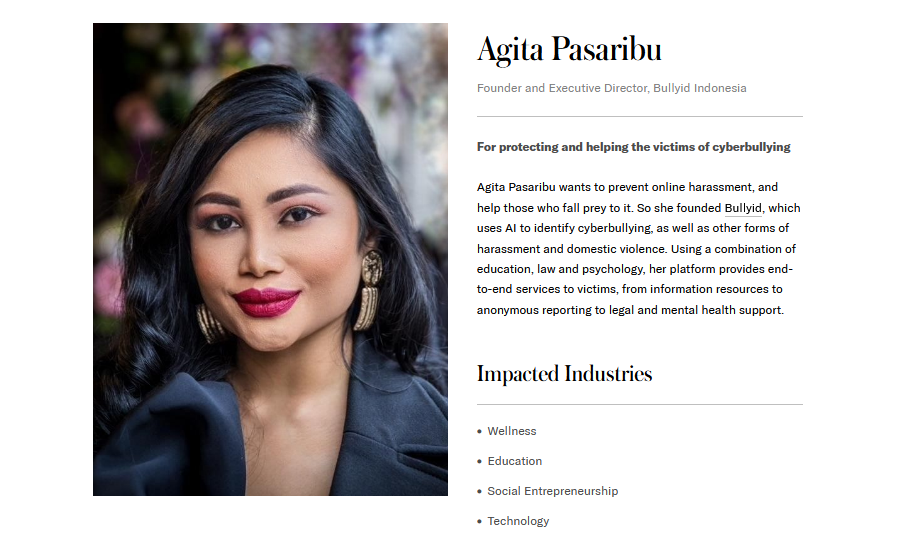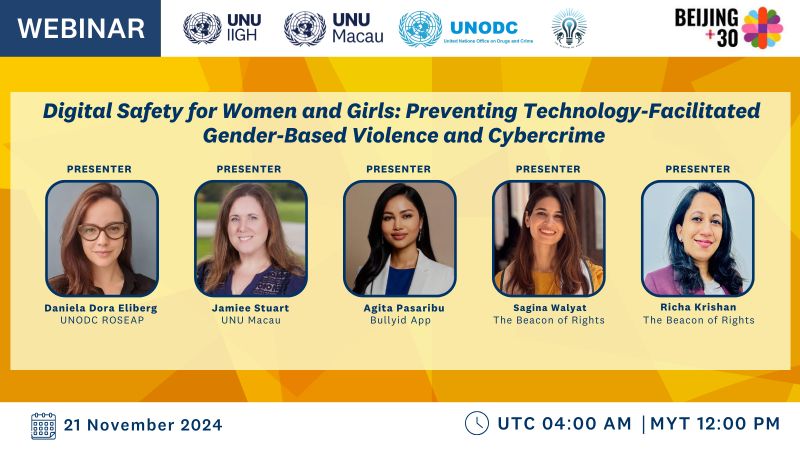
How can we ensure internet users are safe from harm, particularly women and girls? As part of the Beijing+30 Action Agenda initiative, a webinar aimed to answer that question. Titled “Digital Safety for Women and Girls: Preventing Technology-Facilitated Gender-Based Violence and Cybercrime,” the webinar spotlighted our Executive Director, Agita Pasaribu, and other women changemakers from around the world who advocate for better digital safety: Daniela Dora Eliberg (UNODC ROSEAP), Jamiee Stuart (UNU Macau), and Sagina Walyat and Richa Krishan (The Beacon of Rights).
On November 21, 2024 at the Ministerial Conference reviewing the Beijing Declaration, Agita presented a case study on gender-based violence in the Indonesian digital space. The study found three major types of online gender-based violence: cyber grooming and blackmail (sextortion), monetization of non-consensual intimate image (NCII) content, and deepfake pornography. These issues cause a great deal of harm on their victim-survivors, such as loss of privacy, severe psychological trauma, and reputational harm. Furthermore, perpetrators often target users that are already economically and socially disadvantaged, such as women from low-income households.
While victim-survivors recognize the effects of the abuse they endured, it is uncommon for many to seek justice. Many victims refuse to report their case not just due to a lack of knowledge and access, but also due to fear of revictimization from law enforcement. The complex process victims have to go through simply for reporting their abuse can also be damaging. Lastly, if the case involved victims or perpetrators in different countries, cross-border jurisdictions have posed a greater challenge in effectively resolving issues. Agita also mentioned how the currently available systems are limited in preventing and addressing gender-based violence. This includes the lack of dedicated institutions for addressing such crimes, lack of transparency and technology, as well as inadequate sexuality education.
The fight against technology-facilitated gender-based violence cannot be done alone. Governments, organizations, and online platforms need to cooperate in enforcing stricter policies against perpetrators, investigating and prosecuting local and cross-border cases, and providing support as well as education to victim-survivors. Additionally, from a technical standpoint, online platforms need to implement enhanced detection and moderation systems to address latent and emerging threats.
Bullyid App is open to collaborations and partnerships in combating gender-based violence in the digital world. For more information, visit our website: https://bullyid.org/invite-us/.