
Six Years In: From Bullyid App to Safeintech
A reflection on how we started, what six years of supporting people through online harm has taught us, and what we believe needs to be built next.
In early 2020, Indonesia entered a public health emergency and began implementing large-scale social restrictions, or Pembatasan Sosial Berskala Besar (PSBB). Schools closed, offices moved home, physical services became difficult to reach, and many parts of everyday life moved online almost overnight. The technology existed to make that transition possible, but much of our social infrastructure, particularly legal, psychological and victim-support services, had never been designed to be equally accessible through a screen.
Bullyid App did not begin with a business plan, a theory of change or even an intention to build an organisation. It started because a friend of mine needed help.
She was being blackmailed by someone she believed cared about her, someone she had trusted but had never met in person. By the time she came to me, she was constantly afraid that something private would be published, she was barely sleeping, and she had started sending money because she did not know what else would make the threats stop.
At that moment, my objective was very small. I wanted her to stop being afraid, sleep without worry, and I wanted her to stop sending money to the offender.
I wrote a formal legal notice on her behalf, what we commonly call a surat somasi in Indonesia, and sent it to the person threatening her. Shortly afterwards, he blocked her across the platforms they had been using. I helped her set up Google Alerts, walked her through reverse-image searches and tried to create a simple system so that she would know if something appeared online.
That was it.
Except I could not stop thinking about one question: if this happened to someone close to me, how many other people were dealing with the same thing without knowing who to call?
What I thought this would be (just) a lockdown project...
During the COVID restrictions, I began gathering volunteer lawyers, psychologists and counsellors who were willing to provide support online and pro bono. I genuinely believed this would be a temporary passion project. We would help people while physical services were harder to reach, restrictions would eventually ease, and then everyone would return to their normal work.
Instead, more than 750+ cases came to us during one week of online volunteering.
At the time, we were operating under the name CovidCare Bully.id. Young people began sharing the service, communities amplified it, media organisations covered it and eventually the work reached Indonesia's Ministry of Women Empowerment and Child Protection, where we were invited to explain what we were seeing.
Even after the covid lockdown eased, cases keep coming to us, so we keep going.
People sometimes ask why the organisation was called Bully.id, and the answer reflects how early the conversation around online harm still was in Indonesia. Terms that are now increasingly familiar, such as technology-facilitated gender-based violence, image-based abuse or non-consensual intimate imagery, were not the terms most people typed into a search bar when something happened to them. The word people knew was bullying.
Someone experiencing it was being bullied. I changed the spelling slightly and Bullyid emerged.
It was not intended to be a perfect taxonomy for every form of digital harm. It was intended to be something people might actually find. Somehow, it worked. We began appearing in searches, people found us, and their experiences started teaching us how much more complicated the problem really was.
Consent changes everything...
In 2021, many of the people coming to us had voluntarily created or shared an intimate image with somebody they trusted. They had met through an online dating service, a game, social media or an existing relationship. The original act had been consensual, but the distribution, threats or extortion that followed were not.
At the time, that distinction was frighteningly difficult for many survivors to navigate.
Indonesia already had laws governing pornography and electronic content, but many people were afraid that seeking help could expose them to blame or even legal consequences because they had originally participated in creating or sharing the material.
We began raising these concerns with the government and contributing evidence from the cases we were seeing.
In 2022, Indonesia enacted Law No. 12 of 2022 on Sexual Violence Crimes, known as UU TPKS. It was the result of years of work by women's rights organisations, survivor advocates, legal experts, government and many other civil-society actors, and we were proud that our small organisation could contribute evidence and advocacy to that wider movement. The law established electronic-based sexual violence as a recognised category and addressed conduct including sexual recording or imaging without consent, electronic transmission of sexual material and circumstances involving coercion, threats or extortion.
That moment reinforced something we still believe today, that frontline support and policy should not exist in separate worlds. When enough people tell you where a system is failing, those experiences should eventually change the system.
Six years later...
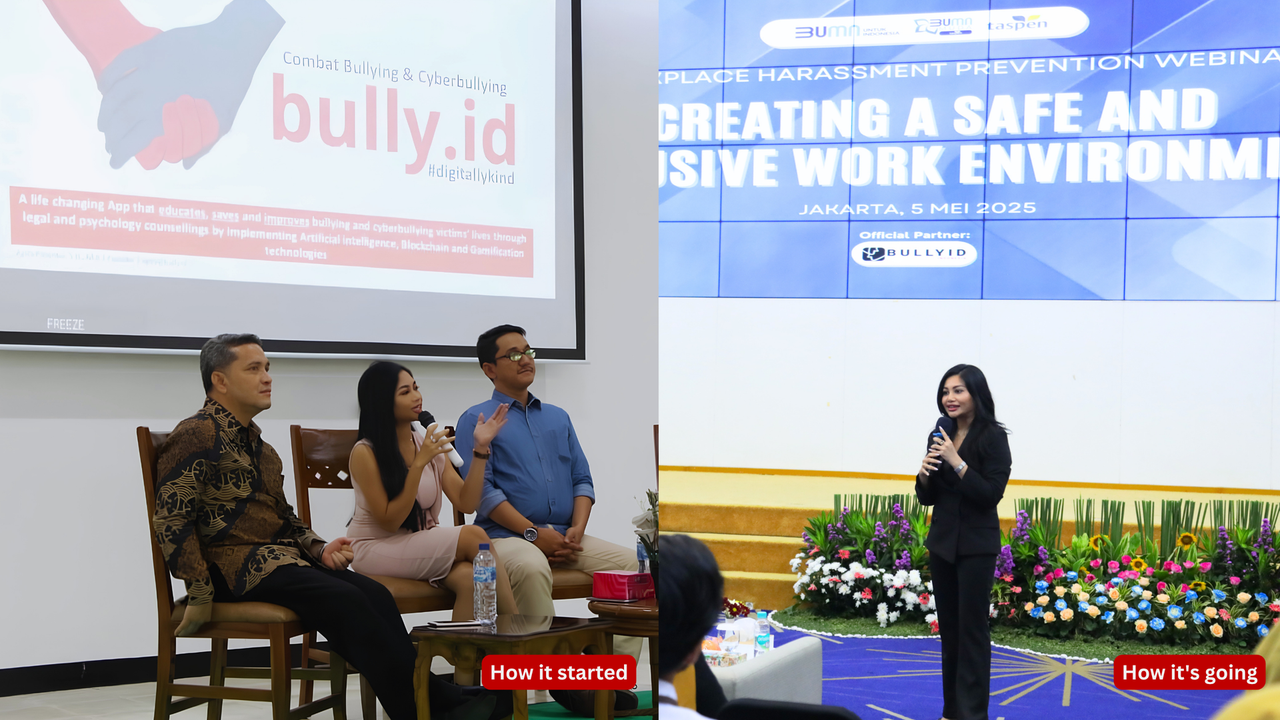
Today, Bullyid App operates as a technology nonprofit under NMA Foundation.
As I write this, more than 260,000+ cases have come through our direct support services, while our awareness activities, digital campaigns, training programmes and online resources have reached more than 2.3 million people.
Our web-based platform allows people to seek psychological support, understand their legal options and receive assistance navigating escalation and content-removal processes.
We work with trusted professionals and maintain escalation relationships with platforms including Meta and TikTok. Over time, we have also learned that one enormous reporting page is not necessarily helpful to someone arriving in distress, so we have organised the experience into five clearer support hubs that help people understand which door they should enter without requiring them to understand our organisational structure first.
None of that was part of the plan in 2020.
Most of it was built because somebody arrived with a problem our existing system could not answer. That remains one of the most important principles behind how we build.
The nature of the harm is changing
During the earlier years of Bullyid App, much of the online gender-based violence reaching us involved harassment, threats, defamation, sextortion and what was still commonly described as "revenge porn", although we have deliberately moved away from that terminology because abuse is not defined by a perpetrator's motivation for revenge.
Then generative AI became widely accessible.
Beginning around 2024, we started seeing a meaningful change in our case mix. AI-generated sexual and intimate imagery became increasingly common, and our internal case data now shows that approximately 35 to 42 percent of cases in some months involve forms of AI-enabled harm.
The person depicted may never have created an intimate image at all. Someone may take an ordinary photograph from social media, a school page, a professional profile or a public appearance and use generative technology to create something that looks intimate or sexual. The resulting image can then be distributed through messaging groups, social platforms, forums or private networks with almost none of the friction that would once have been required to manipulate an image convincingly.
This fundamentally changes the burden placed on a survivor. Six years ago, we were frequently helping someone demonstrate that an authentic intimate image had been shared without their consent.
Increasingly, we are also helping people answer an earlier question: is this image even real?During Indonesia's 2024 election period, we were contacted by supporters of a female political candidate who wanted help understanding whether sexualised imagery circulating about their candidate was authentic or manipulated. That year was difficult for us organisationally because requests were no longer confined neatly to survivor support. We received requests involving sexualised content, political defamation, verbal harassment, misogynistic commentary, memes and satire, and we had to continuously distinguish genuine abuse from political expression that simply made somebody uncomfortable.
We were also digitally attacked more than once by people who disagreed with what we were doing.
Those experiences forced us to become much more precise about our role. An online-safety organisation cannot become a mechanism for suppressing criticism, journalism, political disagreement or legitimate speech simply because somebody reports it as harmful. At the same time, freedom of expression should not become an excuse for sexualised fabrication, coercion or targeted technology-facilitated abuse.
Cross-border jurisdiction
More people outside Indonesia began using our platform, some told us they were being blackmailed by Indonesians they had met online. Others had found our resources through search engines or social media and simply needed somewhere to start.
Online harm can happen to anyone, from anywhere, at any time. The infrastructure supporting people cannot remain entirely national when the platforms, perpetrators and technologies involved are global.
Why Safeintech?
That ambition is larger than the name Bullyid App was originally created to carry.
For six years, Bullyid App has taught us how people experience harm, what they need when they first ask for help and where existing systems fail them. We are not leaving those lessons behind. We are building outward from them.
Our next chapter will be Safeintech (safeintech.org)
The name is deliberately simple because the idea behind it is simple, that people should not have to withdraw from technology in order to be safe. They should be able to be safe within it.
We do not believe the future of online safety is a world where people are repeatedly told to delete their accounts, stop sharing, stop dating online, avoid gaming communities, stay away from new technologies or become responsible for predicting every possible way somebody might abuse them.
Technology will become more embedded in our lives, not less.
Our responsibility is therefore to build better support, stronger safeguards and more intelligent infrastructure around the people using it.
Safeintech will carry forward the survivor-centred work of Bullyid App while allowing us to think beyond a single harm category, a single country and a single technological generation.
What we want to build next...
We will continue legal and psychological support, while creating a network that can extend beyond Indonesian expertise. Instead of giving somebody a list of organisations to Google after we discover that their case falls outside our jurisdiction, we want vetted local partners to become part of the same support pathway. A survivor should be able to move from first contact to a qualified local organisation through a warm handoff, with clear consent and appropriate safeguards, without starting from zero.
We will continue working with technology platforms on escalation and removal. Our relationships with Meta and TikTok have shown us that civil-society organisations can play an important role between platform systems and people experiencing harm, particularly when automated reporting tools cannot understand context. We want to strengthen that bridge, and pursuing more relationships with other platforms.
We will integrate StopNCII more directly into the support journey. This year we became part of the StopNCII global clearing ecosystem, and our intention is to make access to its protective infrastructure available from within our platform rather than expecting users to discover another tool independently. StopNCII's approach relies on hashes that participating platforms can use to identify matching intimate imagery, and its effectiveness grows as more platforms participate.
We will build a cross-border legal knowledge layer. A person should be able to understand which rights, reporting options and support mechanisms may be relevant where they are, while being clearly told when professional legal advice is required. We want AI to help retrieve, organise, translate and maintain that knowledge, with citations, versioning and local expert validation. The goal is not an AI lawyer that invents answers. The goal is infrastructure that helps people and professionals reach trusted legal knowledge faster.
We will introduce AI-assisted triage for the hours when our human teams are not immediately available. This should not mean replacing counsellors, psychologists or lawyers with a chatbot. It means that somebody reaching us late at night should still be able to explain what has happened, identify an urgent safety concern, receive appropriate information about evidence preservation and digital security, understand what support is available and enter the right queue for human follow-up. Technology should extend the availability of human support rather than become an excuse to remove the human being.
And we will build deepfake and synthetic-media detection into the platform, because increasingly, determining what happened requires understanding whether the media itself has been manipulated.
What six years have taught me...
When I look back at 2020, what surprises me most is how much the problem has changed while the underlying human need has remained almost exactly the same.
My friend did not need to understand platform governance, evidence standards, jurisdiction, hashing, generative AI or the taxonomy of technology-facilitated gender-based violence. She needed somebody to believe that the situation mattered, help her understand what she could do next and help her to get out of the problem.
Six years later, that is still what most people need when they find us, but the systems surrounding that moment have simply become lot more complicated.
The next generation of Safeintech therefore cannot be built only by adding more features to a website. It will require lawyers, psychologists, survivor organisations, researchers, AI companies, platforms, digital-forensics specialists, policymakers, funders and people with lived experience to build infrastructure together.
We know how to support people after something has gone wrong because survivors have spent six years sharing their cases to us.
Now we want to use those lessons to build systems that can identify harm earlier, connect people to help faster, operate across borders more responsibly and make safety a more fundamental part of how technology is designed and used.
Build Safeintech with us.
If you are building technology for detection, provenance, content safety or responsible AI, we want to learn with you. If you provide trusted legal, psychological or survivor support in your country, we want to build pathways with you.
If you are a platform trying to make escalation and redress work better, we want to bring frontline evidence into that process. If you fund public-interest technology, we want to show that survivor support can be infrastructure, not simply a short-term programme.
And if you have ever used Bullyid App, volunteered with us, trusted us with your story, challenged our thinking, referred somebody to us, funded our work or simply told another person that help existed, then you have already helped build this. Thank you.
Six years ago, I thought I was helping one friend get through one terrible night.
We went a little further than I expected.
I think we are only beginning.
Why Deepfake Detection Matters
Before we discuss how we will use it
We are building deepfake detection into Safeintech because the nature of the harm we see is changing.
In the past, many cases involved an authentic intimate image being shared without consent. Increasingly, people are being targeted with images or videos that were created or altered using generative AI. In these cases, the person depicted may never have created an intimate image at all. An ordinary photograph from social media, a school page, a professional profile or a public appearance can be manipulated into sexualised content and then circulated as if it were real.
That creates a different kind of crisis. Survivors may not know whether the material is authentic, where it came from, who created it or how widely it has been shared. They may also face disbelief because the image looks artificial to some people but convincing to others. Before we can help someone decide what to report, preserve or escalate, we may first need to help them understand what they are looking at.
The "Pink Hijab" Case
In the widely reported "pink hijab" case, an image of a woman wearing a pink hijab was circulated online in a sexualised and misleading context. The image was presented as if it showed the woman in an intimate situation, but reports and subsequent discussion indicated that it had been manipulated or digitally altered. The incident drew public attention because an ordinary image of a woman was transformed into sexualised content and circulated in a way that could damage her dignity, reputation and safety, even though the original photograph itself was not intimate.
The case also showed how quickly manipulated content can become detached from its source. Once an image is reposted, screenshotted and shared across messaging groups and social platforms, the person targeted may have little ability to explain the original context or stop the material from spreading. Whether the manipulation is technically sophisticated or relatively crude, the consequences can still be serious when people believe it, use it to harass the person depicted or combine it with threats and extortion.
The "pink hijab" incident is therefore important not only as a story about one manipulated image, but as an example of why online-safety support must account for synthetic and altered media. It demonstrates that the harm can begin with an ordinary, non-intimate photograph and that the first question for a support service may be whether the content has been manipulated at all.
Detection Is Not Binary
Deepfake detection sounds deceptively simple when described as a binary question: real or fake?
In practice, it is not. Truth online will increasingly require multiple kinds of evidence, as our job is to make those signals understandable and useful to the person who needs them.
Detection systems are trained on different datasets, generators and forensic signals, which means a tool can perform extremely well on the kinds of manipulation it has previously seen and perform much worse when confronted with a new model, a compressed screenshot, a cropped image or material that has travelled through several social platforms.
NIST is now developing operationally realistic evaluations specifically because the gap between laboratory performance and deployment performance remains substantial. Its current deepfake evaluation programme notes significant performance degradation when detection systems move from academic testing into operational conditions. Recent research similarly shows that cross-dataset performance can fall sharply when detectors encounter unseen manipulation methods or compression characteristics.
Our Approach: Multi-Aggregator Model
Instead of relying on one detection provider, we want to query several technically different detection systems and compare their outputs, confidence levels and areas of disagreement. Where available, those results can also be considered alongside provenance information, metadata, known-source matching, image history and other forensic signals.
High-stakes decisions may still require specialist forensic review, and no automated detector should ever become a mechanism for deciding whether a survivor is credible.